

Free Consultations 312-627-9482

Am I Going To Be Convicted of DUI if I Failed a Field Sobriety Test?
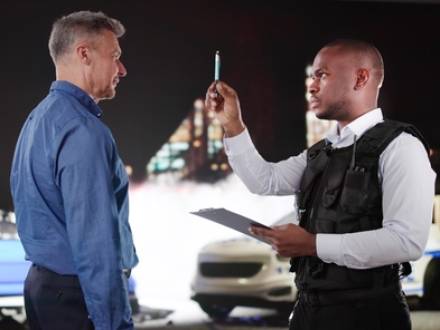 A failed field sobriety test is not a guaranteed DUI conviction. These roadside exercises are far from foolproof, and courts recognize that. Officers are trained to look for specific signs of impairment, but what they observe can be influenced by factors that have nothing to do with alcohol or drugs. The results are not scientific measurements. They are one officer's interpretation of how you performed under pressure, and that interpretation can be challenged. If you are facing a DUI charge after failing field sobriety tests in 2026, a Chicago DUI defense lawyer can take a hard look at what actually happened during your stop and start building a defense based on the real facts of your case.
How Is a Field Sobriety Test Used in Illinois DUI Cases?
When a police officer suspects a driver may be impaired, they often ask that driver to perform a series of roadside exercises before making an arrest. The first tracks involuntary eye movement as the driver follows a moving object with their eyes. The second asks the driver to walk heel to toe in a straight line, turn around, and walk back. The third requires the driver to lift one foot off the ground and hold it there for a set period of time without losing balance. Officers use the results of these tests to justify making a DUI arrest.
The results are written into the officer's report and can be used as evidence against you in court. But they are not scientific proof of intoxication. They are the officer's interpretation of how you performed, and that interpretation can be challenged.
Why Are Field Sobriety Tests Not Always Reliable?
Field sobriety tests have real limitations. Even under perfect conditions, research has shown they produce incorrect results a meaningful percentage of the time. When conditions are not perfect, the error rate goes up even more.
Many things that have nothing to do with alcohol or drugs can cause someone to fail these tests. Nervousness, anxiety, physical conditions, injuries, and medical issues like inner ear problems or neurological conditions can all cause someone to perform poorly on these tests. The environment matters, too. Uneven surfaces, poor lighting, bad weather, and the type of footwear a person is wearing can all affect how they perform. Personal factors like age and weight can also play a role in how someone performs on a roadside exercise.
If any of these factors impacted your stop, they are relevant for challenging the test results.
How Will Your Attorney Challenge an IL Field Sobriety Test?
There are specific ways a defense attorney can attack field sobriety test results in a DUI case. Some of the most effective include:
-
Proper NHTSA standardized procedures were not followed when the test was administered.
-
The ground where the test took place was uneven, sloped, or slippery.
-
There was not enough light at the scene for the test to be conducted fairly.
-
The instructions given before the test began were unclear or incomplete.
-
The administering officer was not properly trained in standardized field sobriety testing procedures.
-
A physical condition, injury, or disability affected the driver’s performance.
If any of these factors exist, the test results may not be reliable. A judge may decide they should not be used as evidence against you.
Can Field Sobriety Test Results Be Kept Out of Evidence in an Illinois DUI Case?
If a defense attorney can prove that the test results shouldn’t be considered, a judge may suppress them. Suppression means the results cannot be used by the prosecution at trial.
If the field sobriety test results are suppressed and there is no other strong evidence of impairment, the prosecution's case can be significantly weakened. In some cases, it can fall apart entirely.
What About the Breath or Blood Test?
A breath or blood test is present in many DUI cases alongside field sobriety test results. Illinois's DUI statute, 625 ILCS 5/11-501, sets the legal limit at 0.08 percent blood alcohol content, and a result at or above that level can be used as evidence that the driver was under the influence. When a chemical test result exists, prosecutors tend to treat it as the centerpiece of their case.
But a chemical test result is not beyond challenge either. Questions about whether the breathalyzer was working correctly, whether it had been properly calibrated, how the blood sample was collected and stored, and whether the testing process followed required procedures are all areas a defense attorney can explore. And even when a chemical test result is part of the case, successfully challenging the field sobriety test results still matters. Undermining both pieces of evidence together makes the prosecution's overall picture of impairment much harder to sell to a jury.
What Does a Failed Field Sobriety Test Actually Prove in a DUI Case?
On its own, a failed field sobriety test only proves that you did not perform well on a roadside exercise under stressful conditions. It does not prove you were drunk. It does not prove that your ability to drive was impaired. The officer's notes about your performance are their subjective interpretation, not an objective measurement.
The prosecution has to prove beyond a reasonable doubt that you were impaired. A failed field sobriety test is one piece of evidence they may try to use, but it is not the whole case. It is also not automatically convincing to a judge or jury, especially when the defense demonstrates the real reasons for the performance.
Schedule a Free Consultation With Our Cook County, IL DUI Defense Lawyer
Failing a field sobriety test does not automatically mean you will be convicted of DUI. The Chicago DUI defense attorney at Law Offices of James F. DiQuattro is accomplished, aggressive, and dedicated to going the extra mile for every client. He fights hard to challenge the evidence, protect your rights, and pursue the best possible outcome in your case. Call 312-627-9482 to talk about what happened during your stop and understand your options.










CALLS ANSWERED 24/7
Schedule a free consultation and work with a lawyer that goes the extra mile.
Office Location
900 W. Jackson Blvd., Suite 5-East
Chicago, IL 60607
312-627-9482